https://abcnews.go.com/US/wireStory/study-universe-expanding-faster-younger-62656475
2019-04-26 16:46:00Z
52780276911842
NASA, FEMA, and other national and international agencies are once again gearing up for a hypothetical asteroid impact preparedness scenario. They hope to learn the best strategies for responding to a potential strike, starting from the moment a threatening asteroid is first detected by astronomers.
Next week marks the start of the International Academy of Astronautics Planetary Defense Conference. As part of this conference, NASA’s Planetary Defense Coordination Office will team up with other partners to perform a “tabletop exercise” on how they’d handle the news of a (fictional) asteroid on a collision course with Earth.
Again, the following is fictional.
On March 26, 2019, astronomers discover an asteroid in the night sky, far dimmer than Pluto to their telescopes. They name it 2019 PDC. Initially, it appears that the asteroid’s eccentric orbit bring it within approximately 18 times the Moon’s distance from the Earth, with a chance of hitting the Earth at one in 50,000 in 2027.

Advertisement
Astronomers continue to track the object as it gets closer. They learn it could be somewhere between 100 and 300 meters wide—the size of a skyscraper. After a month of tracking, the probability of collision with Earth is now 1 percent—the threshold at which international organizations have agreed they must take action.
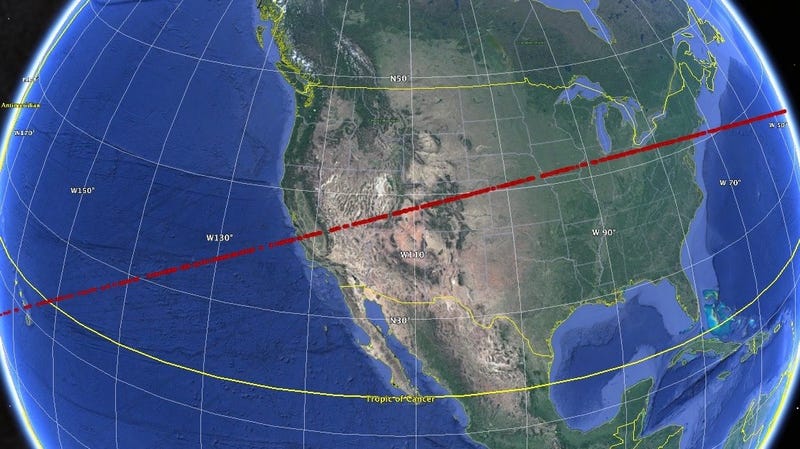
Astronomers are able to create a “risk corridor,” measuring where the asteroid might hit. Its potential paths intersect the United States, some of western Africa, and the Atlantic and the Pacific Ocean.

Advertisement
Though just a drill, these are the kinds of calculations that astronomers must make when a real asteroid comes close to Earth. The fictional 2019 PDC describes a “potentially hazardous asteroid,” the kind that orbits close to Earth and that could have a catastrophic impact if it actually struck the planet. Scientists recently performed a similar simulation to this one, monitoring a nearby asteroid as though it were an actual threat. The new simulation instead will focus less on the scientific questions, and more on governmental response.
This simulation is the sixth near-Earth-object impact exercise that NASA has taken part in. Not only do these exercises help NASA officials think through what they’d do in the event of a threat, but they also help them know what information is most important to FEMA and other agencies.
“What emergency managers want to know is when, where and how an asteroid would impact, and the type and extent of damage that could occur,” Leviticus Lewis of the Response Operations Division for FEMA said in the NASA press release.
Advertisement
We’ll be keeping track of news from the conference next week and reporting on any interesting developments. You can also follow along via a Twitter account run by the European Space Agency, @esaoperations, which will be sharing real-time updates from the exercise.
[unable to retrieve full-text content]
A newly-discovered ancient species is forcing scientists to rethink what exactly counts as a crab.
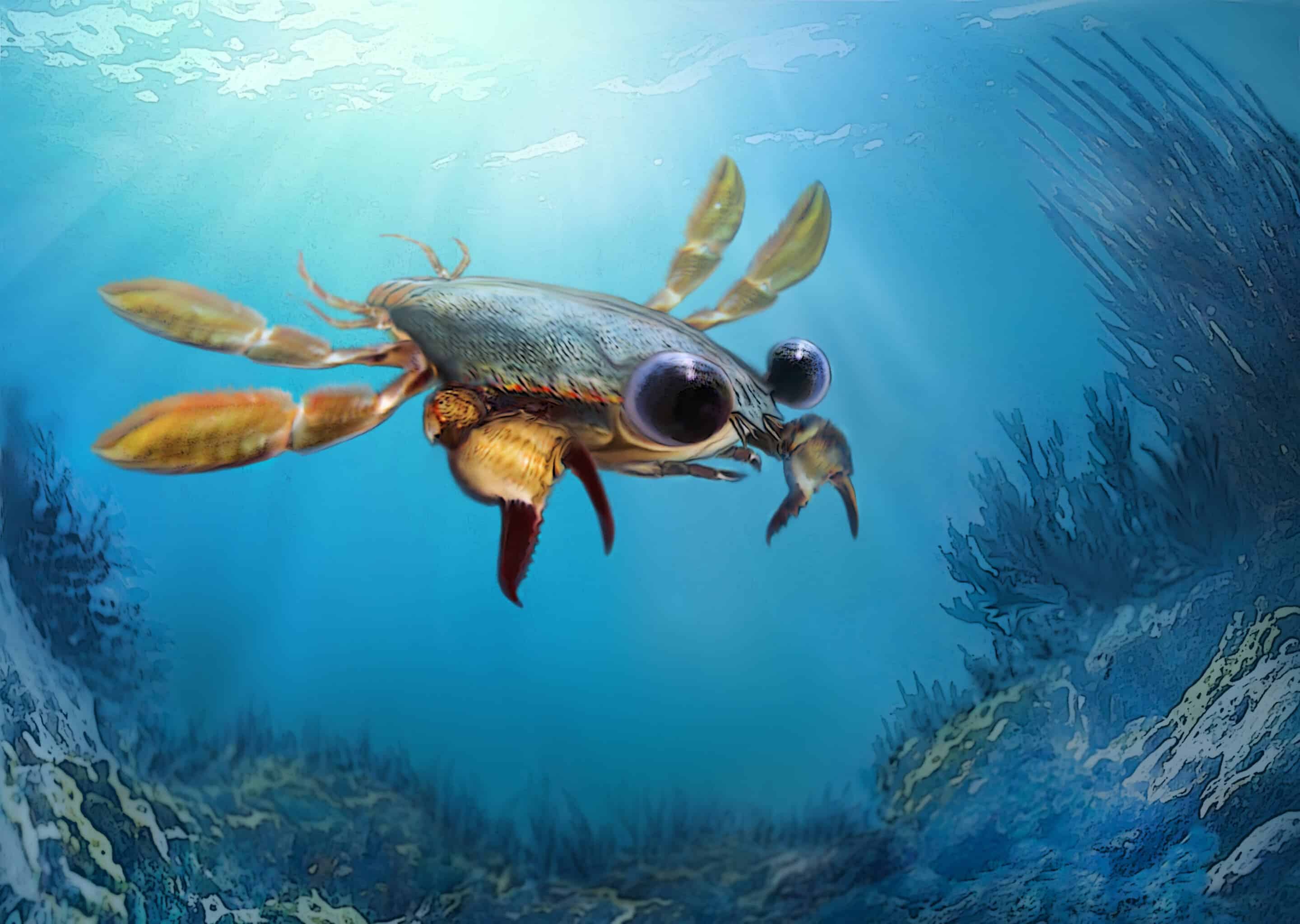
Image credits Oksana Vernygora / University of Alberta.
An international team led by paleontologists from the Yale University announced the discovery of a treasure trove of hundreds of well-preserved crab specimens. The fossils include species of true shrimp, comma shrimp and, most excitingly, a new branch of the evolutionary tree of crabs. The specimens were recovered from Colombia and the United States and date back to the mid-Cretaceous (around 90 to 95 million years ago).
“Callichimaera perplexa is so unique and strange that it can be considered the platypus of the crab world,” said Javier Luque, who led the research efforts.
“It hints at how novel forms evolve and become so disparate through time. Usually we think of crabs as big animals with broad carapaces, strong claws, small eyes in long eyestalks, and a small tail tucked under the body. Well, Callichimaera defies all of these ‘crabby’ features and forces a re-think of our definition of what makes a crab a crab.”

Reconstruction of Callichimaera perplexa.
Image credits J. Luque et al., 2019, Science Advances.
The team writes that Callichimaera perplexa is one of the earliest species of paddle-legged, swimming anthropods we’ve ever discovered, second only to the group of sea scorpions (which lived more than 250 million years ago). It was named for the chimera, a mythological creature whose body included features from several animals. Its full name translates to “perplexing beautiful chimera.”
The specimen, which Luque describes as “unusual and cute”, is definitely perplexing. The ancient crab was quite tiny, about the size of a quarter. It also had a striking pair of large, compound eyes — but no eye sockets. Bent claws, leg-like mouthparts, and a long body ending in an exposed tail completed its visage.
These latter features are typical of pelagic crab larvae to this day, the team writes. This suggests an evolutionary link tying them to the ancient species. The team believes that these traits were retained and amplified in ‘miniaturized adults’ through changes in the timing and rate of development. This process, called “heterochrony,” is one of the mechanisms through which species evolve novel body parts.
“It is very exciting that today we keep finding completely new branches in the tree of life from a distant past, especially from regions like the tropics, which, despite being hotspots of diversity today, are places we know the least about in terms of their past diversity,” Luque said.
The paper “Exceptional preservation of mid-Cretaceous marine arthropods and the evolution of novel forms via heterochrony,” has been published in the journal Science Advances.

On April 10, 2019, the Event Horizon Telescope (EHT) unveiled the first-ever image of a black hole's event horizon, the area beyond which light cannot escape the immense gravity of the black hole. That giant black hole, with a mass of 6.5 billion Suns, is located in the elliptical galaxy Messier 87 (M87). EHT is an international collaboration whose support in the U.S. includes the National Science Foundation.
This image from NASA's Spitzer Space Telescope shows the entire M87 galaxy in infrared light. The EHT image, by contrast, relied on light in radio wavelengths and showed the black hole's shadow against the backdrop of high-energy material around it.
Located about 55 million light-years from Earth, M87 has been a subject of astronomical study for more than 100 years and has been imaged by many NASA observatories, including the Hubble Space Telescope, the Chandra X-ray Observatory and NuSTAR. In 1918, astronomer Heber Curtis first noticed "a curious straight ray" extending from the galaxy's center. This bright jet of high-energy material, produced by a disk of material spinning rapidly around the black hole, is visible in multiple wavelengths of light, from radio waves through X-rays. When the particles in the jet impact the interstellar medium (the sparse material filling the space between stars in M87), they create a shockwave that radiates in infrared and radio wavelengths of light but not visible light. In the Spitzer image, the shockwave is more prominent than the jet itself.

The brighter jet, located to the right of the galaxy's center, is traveling almost directly toward Earth. Its brightness is amplified due to its high speed in our direction, but even more so because of what scientists call "relativistic effects," which arise because the material in the jet is traveling near the speed of light. The jet's trajectory is just slightly offset from our line of sight with respect to the galaxy, so we can still see some of the length of the jet. The shockwave begins around the point where the jet appears to curve down, highlighting the regions where the fast-moving particles are colliding with gas in the galaxy and slowing down.
The second jet, by contrast, is moving so rapidly away from us that the relativistic effects render it invisible at all wavelengths. But the shockwave it creates in the interstellar medium can still be seen here.
Located on the left side of the galaxy's center, the shockwave looks like an inverted letter "C." While not visible in optical images, the lobe can also be seen in radio waves, as in this image from the National Radio Astronomy Observatory's Very Large Array.

By combining observations in the infrared, radio waves, visible light, X-rays and extremely energetic gamma rays, scientists can study the physics of these powerful jets. Scientists are still striving for a solid theoretical understanding of how gas being pulled into black holes creates outflowing jets.
Infrared light at wavelengths of 3.6 and 4.5 microns are rendered in blue and green, showing the distribution of stars, while dust features that glow brightly at 8.0 microns are shown in red. The image was taken during Spitzer's initial "cold" mission.
Explore further
Citation: The giant galaxy around the giant black hole (2019, April 26) retrieved 26 April 2019 from https://phys.org/news/2019-04-giant-galaxy-black-hole.html
This document is subject to copyright. Apart from any fair dealing for the purpose of private study or research, no part may be reproduced without the written permission. The content is provided for information purposes only.
Even Dr. Frankenstein and his monster would be jealous of this creature.
Paleontologists have unearthed the fossil of an ancient crab that lived between 90 and 95 million years ago and is so "utterly bizarre" it literally perplexed the researchers.
Known as Callichimaera perplexa, which means "perplexing beautiful chimera," the crab had an assortment of body parts that would make Mr. Potato Head green with envy.
'GIANT LION' FOSSILS DISCOVERED IN MUSEUM DRAWER
“We started looking at these fossils and we found they had what looked like the eyes of a larva, the mouth of a shrimp, claws of a frog crab, and the carapace of a lobster,“ said Javier Luque, lead author and postdoctoral paleontologist in the Department of Biological Sciences at the University of Alberta and at Yale University, in a statement.
Luque continued: “We have an idea of what a typical crab looks like—and these new fossils break all those rules."
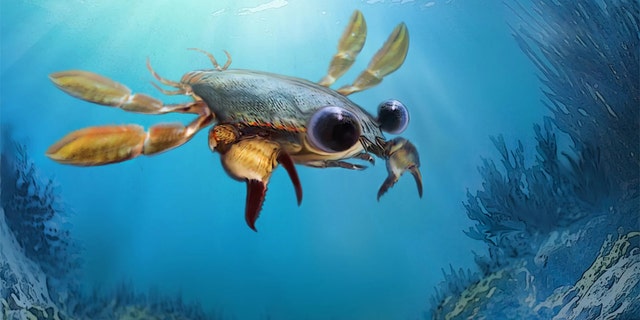
An artistic reconstruction of Callichimaera perplexa: the "strangest crab that has ever lived." (Credit: Oksana Vernygora, UAlberta)
In Greek mythology, a chimera had the head of a lion, the body of a goat and the tail of a snake.
The researchers wrote that the discovery and C. perplexa's body type challenges the conventional view of what earlier crabs looked like. "Our phylogenetic analyses, including representatives of all major lineages of fossil and extant crabs, challenge conventional views of their evolution by revealing multiple convergent losses of a typical 'crab-like' body plan since the Early Cretaceous," the study's abstract reads.
The study was published in the journal Science Advances.
The crab's giant eyes likely helped it to hunt smaller crustaceans while swimming in the ancient Cretaceous period oceans. "We don't think they were filter feeders," Luque told Live Science. "We think they were actually active predators."
C. perplexa was first discovered in 2005 in the Andes Mountains, along with other ancient crustaceans such as lobsters and shrimp. Since then, Luque and a team of researchers have analyzed the fossil (no bigger than a quarter) in great detail and suggested that it spent its life swimming, in stark contrast to modern-day crabs, who spend their lives crawling.
FOSSILIZED REMAINS OF 430 MILLION-YEAR-OLD SEA MONSTER FOUND
“We found dozens of animals, from tiny baby specimens to mature individuals in which we found reproductive organs—a smoking gun that proves these were adult organisms and not larvae. We can even see individual facets on the large compound eyes of these creatures,” Luque added in the statement. “It’s an incredible amount of detail, and we’ve been able to reconstruct them like they were living yesterday."
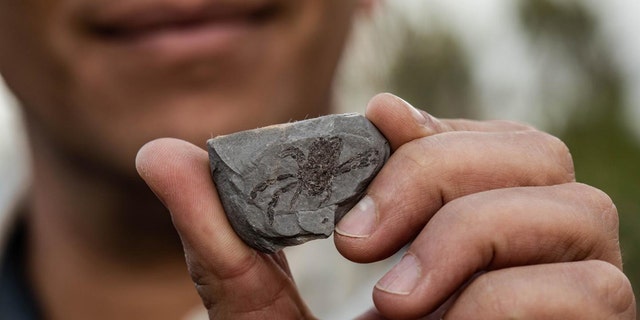
Callichimaera perplexa: the oldest swimming crab from the dinosaur era. (Credit: Daniel Ocampo R., Vencejo Films)
Luque said that it's not unusual to find different body types in older rocks, as life was still expanding into new forms.
“This discovery, from the mid-Cretaceous, illustrates that there are still surprising discoveries of more recent, weird organisms waiting to be found, especially in the tropics," he concluded. "It makes you wonder ‘what else is out there for us to discover?’“
CLICK HERE FOR THE FOX NEWS APP
[unable to retrieve full-text content]
One of Stephen Hawking's Most Famous Theories About Black Holes Just Suffered a Huge Blow Live ScienceA search through the Andromeda galaxy for tiny, ancient black holes finds none, striking a stinging blow to Stephen Hawking's theory of dark matter.
