Selasa, 30 April 2019

'These events are not rare': NASA exercise highlights existential threat of asteroid impacting Earth - New Zealand Herald

It's the doomsday scenario fit for a Hollywood blockbuster — and NASA scientists are about to see it go down.

This week researchers will run an exercise at the 2019 Planetary Defence Conference that will play out a "realistic scenario" of an asteroid flying through space on an impact trajectory with Earth, reports news.com.au

NASA's Planetary Defence Co-ordination Office (PDCO) is running the simulation exercise as part of a recently announced federal "action plan" for defending our planet against asteroid impact.

The hypothetical asteroid is thought to be about 100 to 300 metres in size and only has a very small likelihood of smashing into Earth on April 29, 2027, according to a NASA web page dedicated to the highly detailed scenario.

Advertisement

Global astronomers are always on the lookout for near-Earth objects (NEOs), which are classified as asteroids and comets that orbit the Sun and come within 50 million kilometres of Earth's orbit.

Along with the NASA unit, the European Space Agency's Space Situational Awareness-NEO Segment and the International Asteroid Warning Network (IAWN) are tasked with hunting the skies for potentially dangerous space rocks.

These "tabletop exercises" are not uncommon and are about walking through the steps that will need to be taken along with governments and emergency agencies to mitigate the risk to society should the unthinkable happen.

"These exercises have really helped us in the planetary defence community to understand what our colleagues on the disaster management side need to know," said Lindley Johnson, NASA's planetary defence officer. "This exercise will help us develop more effective communications with each other and with our governments."

NASA has been tasked with the goal of identifying and tracking 90 per cent of near-Earth meteors that are larger than 140 metres by the year 2020. But the task could end up taking nearly three decades, experts claim. And even then we're far from protected.


Last month, it was revealed a relatively small and undetected meteor blew up over the Bering Sea, off Russia's Kamchatka Peninsula on December 18. The explosion — which happened 25.6 kilometres above the Earth's surface — released 10 times the energy produced by the atomic bomb dropped on Hiroshima in World War II.

Six years ago, a meteor exploded over the Russian city of Chelyabinsk and released a shockwave that shattered thousands of windows and injured more than 1600 people. That meteor was only 19 metres wide.

A meteor streaks through the sky over Chelyabinsk, Russia, in 2013. Photo / AP

"The thing is the one over Chelyabinsk and this latest one (in December) are about 10 times smaller" that the ones targeted by the NASA mandate, astronomer Alan Duffy explained to news.com.au last month. "It's far harder to detect those, and we still haven't found all the larger asteroids yet."

He has called for more funding to be allocated to monitoring systems, asserting "it is just a matter of time before one of these blasts occur over a city and cause incredible damage".

During a keynote address at the opening of the Planetary Defence Conference, NASA administrator Jim Bridenstine warned preparing for an asteroid impact is something that needs to be taken very seriously.

"We have to make sure that people understand that this is not about Hollywood, it's not about movies. This is about ultimately protecting the only planet we know, right now, to host life, and that is the planet Earth," he said.
"These events are not rare, they happen."

Let's block ads! (Why?)


https://www.nzherald.co.nz/world/news/article.cfm?c_id=2&objectid=12226623

2019-04-30 06:24:32Z
52780277812415

SpaceX resupply launch delayed by malfunction on space station - Spaceflight Now

A portion of a solar array wing on the International Space Station is visible in this image. Credit: NASA

A SpaceX Dragon supply ship packed with nearly three tons of experiments, crew provisions and supplies will remain on the ground until at least Friday morning to allow more time for NASA flight controllers to troubleshoot a problem with an electrical distribution unit on the International Space Station.

Multiple sources said the commercial resupply launch, previously scheduled for Wednesday, will be pushed back at least two days to no earlier than Friday at 3:11 a.m. EDT (0711 GMT).

The delay will allow time for NASA flight controllers at the Johnson Space Center in Houston to continue troubleshooting an issue with a distribution box in the space station’s electrical power system. Engineers detected an issue with the Main Bus Switching Unit on Monday morning, and ground teams may elect to replace the component later this week, ahead of the SpaceX cargo launch.

The unit is one of several that routes power from the space station’s U.S. solar arrays to the research outpost’s electrical channels. The suspect unit distributes power to two of the eight electrical channels on the station, including a power supply for the space station’s robotic arm, which the station astronauts will use to capture the Dragon cargo craft as it approaches the complex.

While the robotic arm remains powered through a separate channel, NASA flight rules require redundant power supplies for the arm during critical operations, such as the grapple of a free-flying spacecraft.

Ground teams have replaced a failed Main Bus Switching Unit using the station’s robotic arm before. The capability to robotically replace the power distribution box means astronauts may not have to conduct a spacewalk for the task.

The electrical system glitch does not pose any immediate concern to the station or its six-person crew, NASA said.

NASA’s Orbiting Carbon Observatory-3 (OCO-3) and the U.S. military’s Space Test Program-Houston 6 (STP-H6) payloads are in view installed in the trunk of SpaceX’s Dragon spacecraft inside the SpaceX facility at NASA’s Kennedy Space Center in Florida on March 23, 2019. Credit: NASA

“Monday morning, teams identified an issue with the International Space Station’s electrical power system and are working to identify the root cause and restore full power to the system,” the space agency said in an updated posted on its website.

In the update posted Monday afternoon, officials said engineers were examining an unspecified issue with a Main Bus Switching Unit.

“Flight controllers have been working to route power through the remaining six power channels,” NASA said. “Electrical power generated by the station’s solar arrays is fed to all station systems through these power channels.”

NASA said Monday afternoon that managers were discussing how the power system problem might impact plans for the SpaceX resupply launch.

If the Dragon spacecraft had launched Wednesday, it was due to arrive at the station early Saturday. Assuming a launch from Cape Canaveral on Friday morning, the Dragon cargo freighter is scheduled to reach the complex early Sunday.

Email the author.

Follow Stephen Clark on Twitter: @StephenClark1.

Let's block ads! (Why?)


https://spaceflightnow.com/2019/04/30/spacex-resupply-launch-delayed-by-malfunction-on-space-station/

2019-04-30 05:59:21Z
52780278992745

Senin, 29 April 2019

What if a killer asteroid were headed toward Earth? NASA plans to find out this week - NBC News

By David Freeman

Think of it as a crash course in averting asteroid crashes.

As part of the 2019 Planetary Defense Conference, NASA, the Federal Emergency Management Agency and their international partners will conduct a so-called tabletop exercise designed to show how they would react to the discovery of a fictional asteroid heading our way.

The exercise is being conducted as part of a federal "action plan" for defending Earth against asteroids that was announced last June. It will play out over the five days of the conference, which begins in College Park, Maryland, on Monday and runs through May 3. You can watch it live in the player below.

"Exercises like this have been run at several conferences over the years, and government agencies have also ​had them," Andrew Rivkin, a planetary astronomer at Johns Hopkins University Applied Physics Laboratory in Laurel, Maryland, and an expert on asteroids, told NBC News MACH in an email. "It's definitely worth doing, if only so people are aware of the issues and how complex some of them are."

Rivkin, who said he was participating in the exercise, likened it to a fire drill but added that the consequences of a major asteroid strike "could be very bad (just ask the dinosaurs)," referring to the impact of a six-mile-wide asteroid that is believed to have caused the dinosaurs' demise some 65 million years ago.

According to the loosely scripted scenario, astronomers discover that a make-believe space rock dubbed 2019 PDC has a one-in-100 chance of smashing into Earth in 2027. Participants in the exercise, including the European Space Agency and the International Asteroid Warning Network, as well as NASA and FEMA, will consider how they might mount space missions to investigate and possibly deflect the asteroid — and how the effects of an impact might be mitigated.

Even though 2019 PDC is fictitious, the threat posed by asteroid strikes is all too real. As of the start of 2019, more than 19,000 near-Earth objects (NEOs) had been discovered — and 30 more are discovered each week as astronomers continue to search for them.

"We've only found about one-third of NEOs large enough to cause severe regional damage, so we have a lot of work left to do," Amy Mainzer, an astronomer and asteroid expert at NASA's Jet Propulsion Laboratory in Pasadena, California, said in an email. "We need to build and operate more capable space- and ground-based telescopes, in my opinion," she added.

The animation depicts a mapping of the positions of known near-Earth objects (NEOs) at points in time over the past 20 years. There are more than 18,000 known NEOs, with new ones being discovered at the rate of about 40 per week.NASA/JPL-Caltech

So far, experts haven't identified any large objects on a collision course with Earth.

"We are confident that searches have found anything big enough to be a worldwide problem," Rivkin said in the email. "The space agencies of the world are working together to complete the search programs to make sure the neighborhood is safe, and NASA is planning a mission called DART [for Double Asteroid Redirection Test] to practice deflecting an asteroid just in case we ever need to do so. We don't anticipate having to do so any time in the foreseeable future, but it's good to be prepared!"

Want more stories about asteroids?

SIGN UP FOR THE MACH NEWSLETTER AND FOLLOW NBC NEWS MACH ON TWITTER, FACEBOOK, AND INSTAGRAM.

Let's block ads! (Why?)


https://www.nbcnews.com/mach/science/what-if-killer-asteroid-were-headed-toward-earth-nasa-plans-ncna999031

2019-04-29 16:00:00Z
52780277812415

Weird Black Hole Is Shooting Out Wobbly Jets Because It's Dragging Spacetime - ScienceAlert

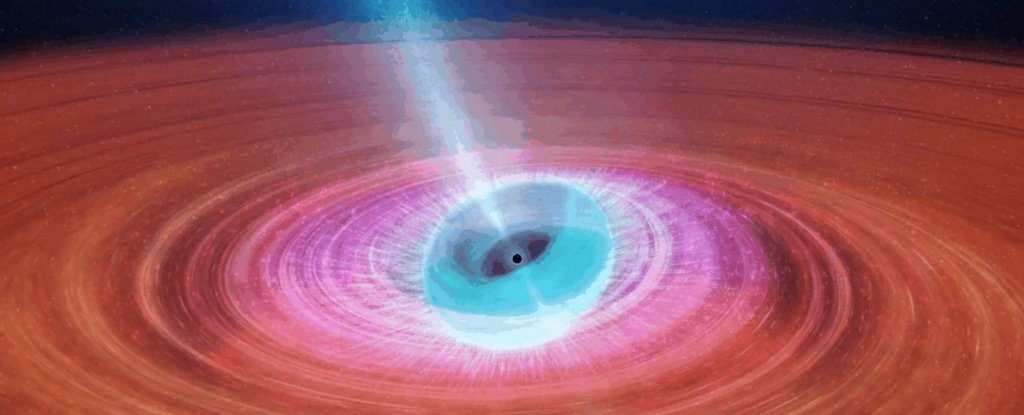
Some 7,800 light-years away, in the constellation of Cygnus, lies a most peculiar black hole. It's called V404 Cygni, and in 2015, telescopes around the world stared in wonder as it woke from dormancy to devour material from a star over the course of a week.

That one event provided such a wealth of information that astronomers are still analysing it. And they have just discovered an amazing occurrence: relativistic jets wobbling so fast their change in direction can be seen in mere minutes.

And, as they do so, they puff out high-speed clouds of plasma.

"This is one of the most extraordinary black hole systems I've ever come across," said astrophysicist James Miller-Jones of the International Centre for Radio Astronomy Research (ICRAR) at Curtin University in Australia.

V404 Cygni is a binary microquasar system consisting of a black hole about nine times the mass of the Sun and a companion star, an early red giant slightly smaller than the Sun.

The black hole is slowly devouring the red giant; the material siphoned away from the star is orbiting the black hole in the form of an accretion disc, a bit like water circling a drain. The closest regions of the disc are incredibly dense and hot, and extremely radiant; and, as the black hole feeds, it shoots out powerful jets of plasma, presumably from its poles.

Scientists don't know the precise mechanism behind jet production. They think material from the innermost rim of the accretion disc is funnelled along the black hole's magnetic field lines, which act as a synchrotron to accelerate the particles before launching them at tremendous velocities.

But V404 Cygni's wobbly jets, shooting out in different directions at different times, on such rapidly changing timescales, and at velocities up to 60 percent of the speed of light, are in a class of their own.

"We think the disc of material and the black hole are misaligned," Miller-Jones said. "This appears to be causing the inner part of the disc to wobble like a spinning top and fire jets out in different directions as it changes orientation."

It's a bit like a spinning top that starts to wobble as it's slowing down, the researchers said. This change in the rotational axis of a spinning body is called precession. In this particular instance, we have a handy explanation for it courtesy of Albert Einstein.

In his theory of general relativity, Einstein predicted an effect called frame-dragging. As it spins, a rotating black hole's gravitational field is so intense that it essentially drags spacetime with it. (This is one of the effects scientists hoped to observe when they took a picture of Pōwehi.)

In the case of V404 Cygni, the accretion disc is about 10 million kilometres (6.2 million miles) across. The misalignment of the black hole's rotational axis with the accretion disc has warped the inner few thousand kilometres of said disc.

The frame-dragging effect then pulls the warped part of the disc along with the black hole's rotation, which sends the jet careening off in all directions. In addition, that inner section of the accretion disc is puffed up like a solid doughnut that also precesses.

"This is the only mechanism we can think of that can explain the rapid precession we see in V404 Cygni," Miller-Jones said.

It's so fast that the usual method radio telescopes use for imaging space were practically useless. Usually, these devices rely on long exposures, observing a region for several hours at a time, moving across the sky to track their target. But in this case, the method produced images too blurred to be of use.

So the team had to use a different method, taking 103 separate images with exposure times of just 70 seconds and stitching them together to create a movie - and sure enough, there were the wibbly wobbly spacetimey jets.

"We were gobsmacked by what we saw in this system - it was completely unexpected," said physicist Greg Sivakoff of the University of Alberta.

"Finding this astronomical first has deepened our understanding of how black holes and galaxy formation can work. It tells us a little more about that big question: 'How did we get here?'"

The research has been published in Nature.

Let's block ads! (Why?)


https://www.sciencealert.com/extraordinary-black-hole-shoots-out-wobbling-jets-as-it-devours-a-star

2019-04-29 15:18:21Z
52780280722798

Scientists find ‘alien’ grain of dust in Antarctica that could challenge our understanding of the solar system - The Independent

[unable to retrieve full-text content]

Scientists find ‘alien’ grain of dust in Antarctica that could challenge our understanding of the solar system  The Independent

A tiny, "alien" grain of dust that was created as a long-gone star died has been found by scientists. The tiny speck of stardust was found inside of a chondritic ...


https://www.independent.co.uk/life-style/gadgets-and-tech/news/alien-grain-of-dust-antarctica-solar-system-life-a8891486.html

2019-04-29 15:00:48Z
CAIiEC0uISdWkkk595TLCRQ3wFAqFwgEKg4IACoGCAowzdp7ML-3CTCRx_0F

Asteroid collision impact drill set for this week - Fox News

World governments have been concerned for decades about a potential asteroid collision and the chaos that would ensue upon Earth. Now, the actions of what agencies around the world would do about it are being shared with the public for the first time ever on social media.

Though the drill is run every two years by asteroid scientists around the world, the European Space Agency has decided to share the event publicly so everyone can see what would happen and what actions might be taken to mitigate the damage.

“The first step in protecting our planet is knowing what’s out there,” says Rüdiger Jehn, ESA’s Head of Planetary Defense, in a statement. “Only then, with enough warning, can we take the steps needed to prevent an asteroid strike altogether, or to minimize the damage it does on the ground.”

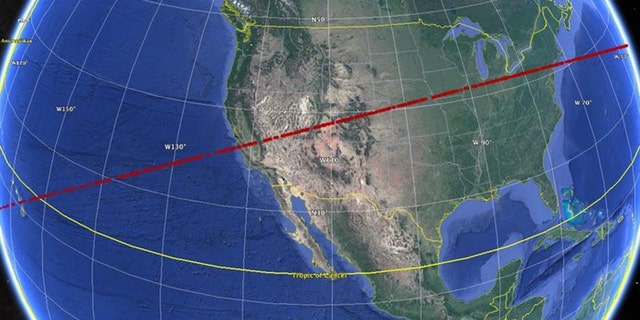
Graphic showing the hypothetical impact risk corrdior of asteroid 2019 PDC, when its orbit is still not fully known. (Credit: Google Earth, ESA)

Graphic showing the hypothetical impact risk corrdior of asteroid 2019 PDC, when its orbit is still not fully known. (Credit: Google Earth, ESA)

ELON MUSK IS GOING TO HELP NASA SAVE EARTH FROM AN ASTEROID COLLISION

Updates from the drill will be shared on the ESA Operations Twitter account, starting Monday, April 29 and running until May 3.

The first tweet has already been written, with the ESA writing: "A hypothetical asteroid has been 'discovered', and worryingly looks set to impact Earth. Follow the progress of fictional asteroid #2019PDC and the response on the ground, over the next few days of the #PlanetaryDefense Conference. #FictionalEvent🌍☄️"

The asteroid scientists who take part in the drill are doing so as part of the 2019 Planetary Defense Conference, which is put on by NASA's Planetary Defense Coordination Office and the U.S. Federal Emergency Management Agency. The scientists will be assigned different roles, such as "space agency," "astronomer" or "national government," and will work off what each other is doing, the ESA added in the statement.

In 2016, NASA formalized the agency’s prior program for detecting and tracking near-Earth Objects (NEOs) and put it inside its Science Mission Directorate.

Though there are 20,000 asteroids (and counting) whose orbit brings them near Earth, NASA has been expanding its protocols for how to take action from a potential collision.

HOW AMERICA CAN GET ITS SLICE OF THE $1 TRILLION SPACE ECONOMY

Last June, NASA unveiled a 20-page plan that details steps the U.S. should take to be better prepared for NEOs such as asteroids and comets that come within 30 million miles of the planet.

Lindley Johnson, the space agency's planetary defense officer, said at the time that the country "already has significant scientific, technical and operational capabilities" to help with NEOs, but implementing the new plan would "greatly increase our nation’s readiness and work with international partners to effectively respond should a new potential asteroid impact be detected.”

In addition to enhancing NEO detection, tracking and characterizing capabilities and improving modeling prediction, the plan also aims to develop technologies for deflecting NEOs, increasing international cooperation and establishing new NEO impact emergency procedures and action protocols.

ANCIENT ASTEROID STRIKES ON MARS MAY HAVE 'PRODUCED KEY INGREDIENTS FOR LIFE'

Earlier this month, NASA awarded a $69 million contract to SpaceX, the space exploration company led by Elon Musk, to help it with asteroid deflection via its Double Asteroid Redirection Test (DART) mission.

CLICK HERE FOR THE FOX NEWS APP

Let's block ads! (Why?)


https://www.foxnews.com/science/asteroid-collision-impact-drill

2019-04-29 13:43:32Z
52780277812415

SpaceX readies for early morning launch Wednesday at Cape Canaveral - WFTV Orlando

CAPE CANAVERAL, Fla. - SpaceX is planning to launch thousands of pounds of supplies, research equipment and hardware to the International Space Station early Wednesday.

The launch announcement comes after SpaceX completed a static fire test of its Falcon 9 rocket on Saturday.

Related Headlines

The rocket is set to blast off at Space Launch Complex 40 at Cape Canaveral Air Force Station at 3:59 a.m.


TRENDING NOW:


This launch will mark SpaceX’s 17th mission under NASA's Commercial Resupply Services contract to send cargo to the International Space Station.

WFTV will share coverage of the launch if it happens on Wednesday on Eyewitness News This Morning.


DOWNLOAD: Free WFTV News & Weather Apps

Not near a TV? Click here to watch WFTV newscasts live

Watch Live: Doppler 9 HD

Let's block ads! (Why?)


https://www.wftv.com/news/local/spacex-readies-for-early-morning-launch-wednesday-at-cape-canaveral/944319165

2019-04-28 22:41:15Z
52780278599684